Thursday, October 24, 2019

Isabelo L. Tampinco “ Bewitching Pose “


Collectors choice.

I have written articles in past posts about beginning the journey of becoming a collector of fine art. I have talked about the need to be an educated buyer and to always be cautious in what you purchase.
Being an educated and informed collector is your best protection always.
I have been asked to talk about the sculpture I wrote about in the last post. I have been questioned as to my sincerity in my comments, so as I have now sold the sculpture I will talk about the piece in question.
The name of the sculpture was “ Bewitching Pose “ by Isabelo L. Tampinco signed and dated 1908.
cast marble, H:21” x L:8” x W:7”(53 cm x 20 cm x 18 cm)

I include the article below that was on the internet as source material and it speaks of the life of the sculptor Tampinco.


Tampinco: Bewitching Pose

Isabelo L. Tampinco (1850 - 1933)

Bewitching Pose

signed and dated 1908
marble
H:21” x L:8” x W:7”(53 cm x 20 cm x 18 cm)
Estimate: P 200,000
Providence:

Acquired directly from the artist’s grandaughter, Amparo Z. Tampinco

Lot 86 of the Leon Gallery Auction on 7 February 2015.

Isabelo Tampinco was a Filipino sculptor known for his woodcarvings for churches, most notably the Church of San Ignacio in Intramuros: altar, the pillars, the ceilings and the other intricate portions of the church; public edifices; and homes. Specific examples of his work were polychrome wood figures of saints and angels. Among his works were Manila Cathedral’s famous facade, the high relief on Santo Domingo church’s molave door, the main altar of the Laoag Cathedral, and woodcarvings in San Agustin church. Out of a desire to create a uniquely Filipino style, he incorporated native flora and fauna designs in his sinuous openwork and Art Nouveau whiplash outlines style of woodcarving. Among his native motifs were the banahaw, areca palm, and bamboo. The said detail became known as “Tampinco frames.”

A Chinese mestizo and a direct descendant of Rajah Lakandula, he was born in Binondo, Manila. He was the son of Tampinco y delos Reyes and Maria Justa de Lacandola. He apprenticed in the carving shops of Binondo and Santa Cruz districts and was able to start his career in his 20s. His works dated as early as 1870. When Tampinco began his art, even while he was trained in school with a classical foundation, there was a revival of the gothic style in Europe. These styles became very evident in his design of churches, such as that of the fallen San Ignacio Church. At age 26, he was chosen as the representative of the Philippines at the 1876 Philadelphia Centennial Exposition in the United States. In 1878 Tampinco landed an important commission- the undertaking of the historic Ayuntamiento which neded refurnishing. Tampinco worked on the statues, lions, the
wooden crowns of state chairs and additional ornamentation for Queen Mercedes’ catafalque.

Receiving the “Diploma de Honor” given by the Royal Jury from the Exposicion General de las Islas Filipinas in Madrid, Spain in 1887, was said to be his most important recognition. Other awards and distinctions that Tampingco reaped were the Gold Medal at the Exposicion de Filipinas in 1895, another Gold Medal was at the St Louis Exposition in 1904.

When the Spaniards left and the American colonizers came, Tampinco enjoyed the newfound freedom as he was able to complete majority of his nude sculptures. Most of his works were either plaster of Paris or concrete. During the American Period, Tampinco was to land a few more commissions, including the interior decoration of the National Museum Building and later the Malacanang Palace in 1926 when he was already past his seventies. This female figure from 1908 reflects a lot of Tampinco’s formal training.

At age 15, he enrolled at the Academia de Dibujo y Pintura, Manila’s art academy, and studied sculpture under Agustin Saez and Lorenzo Rocha. He was hailed as one of the most outstanding sculptors of his time and was admired by Jose Rizal , who was his classmate in a modeling class at the Ateneo Municipal de Manila. He also had formal schooling at the Escuela de Artes y Oficios under the tutelage of Agustin Saez and Lorenzo Rocha. Escuela de Artes y Oficios was patterned after the Royal Academy of Painting and Sculpture which was established in 1648 by King Louis XIV of France. At this time (mid to turn of the 19h century) realism in the Classico-Romantic style was highly favored - an artistic style that was at the same time realistic, classical and romantic- an idealized version of the physical reality imbued with a delicate touch of emotion.

Tampinco’s style would show aspects of Neoclassicism, from the 1900s to his death in 1933. This was already the American Period. The style emphasized on “symbolic or allegorical iconography” and his penchant for faithful representation of details and psychological realism. This female figure as an allegorical personification is reminiscent of the neoclassical style. Inspired by Greek and Roman antiquity, this figure integrates classical motifs as the scroll in her hand.
toto gonzalez faved this

Leo Cloma 4mo
Sold on auction for PHP 420,480.


ISABELO TAMPINCO.. “ THE GLADIATORS".


                                                          “ GLADIATORS “    [ original title unknown]                  


      by ISABELO L. TAMPINCO. (19 November 1850 – 30 January 1933)
     “ Gladiators “ is not the original title as that is unknown.

We will do the description of the two sculptors but the sculpture that we will refer to as soldier “B” is in the National Museum of the Philippines and the title on the sculpture is,
“ Soldier Unsheathing his Sword “, Isabelo L. Tampinco, plaster cast, ca. 1880's.

Description of “ THE GLADIATORS “ [original title unknown.]
cast marble.
30.5cm high x 28cm x 20cm.
Base is round 21cm dia. 1.5cm thick.
Signed...... “ I L T “.. 1890. [ both sculptures ]


                                                         "A"                                         "B"

 These two Gladiators that I will describe together, as they are a pair, I will refer to them as “A' and “B” for easy reference.
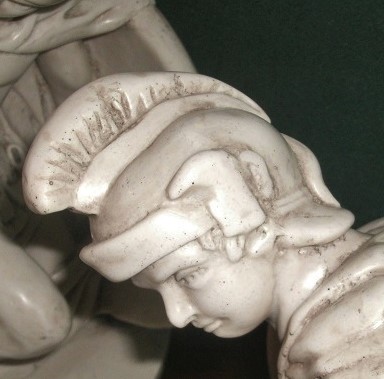
Both Soldiers are dressed in identical uniforms, though there are some subtle differences. They both have on helmets, a cape, and a layered battle skirt, both have on sandals with open toes.
Each Soldier has a sword and scabbard with shoulder strap over the right shoulder and a buckle on the chest for adjustment of the placement of the scabbard on the left hip. They both have a round battle shields that have a design embossed on the outer surface.

What are the differences?

“A” is standing with his sword drawn in his right hand and his shield firmly held by his left arm and hand in the shield grips. The shield is resting on the ground, ready for action.


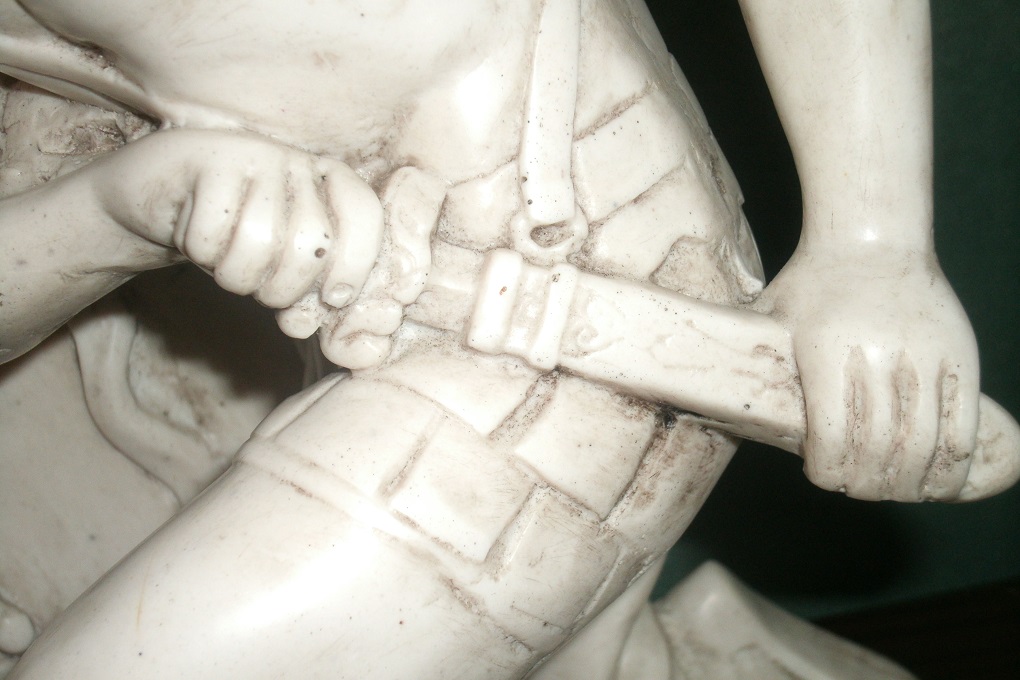
“B” is drawing his sword out of his scabbard with his right hand and holding the scabbard with his left hand. His shield is hanging from his right shoulder by the shoulder strap on the shield and still standing on the ground. 


Soldier “A” is kneeling on his left knee with his right leg bent, he is looking to his right and his head is bent slightly forward. He is wearing a helmet and a clock, caught under the throat.
Soldier “B” is beginning to rise up on his left leg and his right leg is bent under him. He is looking to his left and his head is leaning forward. He is wearing a helmet and a cloak that is caught at the throat.

 “ This work of a Roman soldier [ "B"] crouched behind his shield while unsheathing his sword is one of the earliest works of Isabelo Tampinco.
The facial expression of the soldier and the fluid lines of the composition reflects Tampinco's talent at a young age.”
Pg., 78. “ The life and Art of Isabelo Tampinco” by Santiago Albano Pilar.

Notable differences of each Soldier.

The side flap on the helmet of Soldier “A” is turned down and the side flap of Soldier “B” is still turned up.


                                                                              "B"

                                                                               "A"


The top of the sword scabbard of Soldier “A” has three distinct rings around it, whereas the top of the scabbard of Soldier “B” only has two.


                                                                                "A"

                                                                                "B"


Also the shield of Soldier “B” has a very distinct shoulder strap, whereas there is no shoulder strap on the shield of Soldier “A”.
                                                                               "B"
                                                                              "A"   

 The cloak clasps under the throat of each Soldier are different from each other.
On the sword guard of Soldier “B” there are distinct markings which can be easily seen, but there are no markings on the guard of Soldier “A”.

From the back of the Gladiators.
The Helmets of both Soldiers are little different, on Soldier “A” the back neck guard is round in shape and much longer in length than the neck guard on Soldier “B”. The neck guard on Soldier “B” is not as deep or long as Soldier “A” but is wider across the back of the helmet and squarer in shape with rounded off ends.
The helmet of Soldier ”A” has one strap around the back of the helmet, whereas the helmet of Soldier “B” has two straps.
The tail/tassel on the back of helmet “B” is much longer than the tail/tassel on the back of helmet “A”.

                                                      "B"                                               "A"

 The shields of both Soldiers are covered at the top by their cloaks.
The embossed design on shield “A” is quite different from the design on shield “B”
Both shields at first glance look very similar but closer inspection shows quite a different design on each shield. The design is similar as both are done from a center circle and in four parts but that’s where the similarity stops.


                                                          "B"                                  "A"
Both bases are round.
Both bases are signed “ I L T
                                      1890"


DISTINGUISHING FACTS.
The plaster of paris sculpture, “ Soldier unsheathing his sword ” that is in the National Museum of the Philippines, was not standing on a round base and was unsigned and the card read ca. 1880's.
The base was added later for the marble casting and was clearly signed and dated.
The museums date is ca. 1880 and these sculptures are dated 1890.

Sculpture “A” is also stamped under the cloak beside the shield from the back,
“ UNIVERSAL STATUARY Corp.
CHICAGO, ILL.
c. 1953. 833L.
There is no similar stamp on Soldier “B”. The only conclusion that I can draw is that there was no appropriate place on Soldier “B” to allow the stamp to be inserted, the stamp is quite big.
As these are clearly a pair one stamp was enough.
We have asked why these where molded in Chicago in 1953 and the only answer was that the family chose to mold them there.

                                                                                 "A"


They are clearly Isabelo Tampinco's work, they are in beautiful condition and a wonderful example of early Tampinco sculpture.

I do hope that this post has been of interest to you and helps you with your collection considerations.


Happy collecting

Mark E Shellshear
Art Consultant.
markshellshear@gmail.com

Monday, December 10, 2018

Do it your way.


The pitfalls for Artists entering the Art market is that they try and do it like it was done before and try and take the gallery road and that is frustrating as the Art market has changed so much.
If the local Gallery will not show you, set up your own gallery on social media and push it, you will get attention and you will get noticed and that is what you want.
If you wait around to be discovered, it will not happen, so make it happen, do videos and story tell your Art.
The other thing you have to do is produce work and lots of it, you have little time to rest, paint.
Also you have the freedom to market as you wish, you can again experiment and do things differently.
Make your own path and work hard.
Learn what you need to learn, read that book, do the YouTube seminar, listen to that podcast, it is all out there but you have to find it, learn it and do it.
Finally enter every Art show and Art competition that you can, exhibit anywhere and everywhere, join groups.
If you do this you will get attention, connect with people and build a following.
You do not have time to do it the old way, so do it your way.
When you meet a stranger who loves your work and wants to buy it, sell to them and build a relationship with them and turn them into a friend and lifelong collector.
Choose yourself and do it your way.


Sunday, December 9, 2018

Isabelo Tampinco " Crucifixion."

Isabelo Tampinco " Crucifixion."


Presented by, Mark E Shellshear.
                      Art consultant.

Wednesday, December 5, 2018

Focus on what is important.


There is no enjoyment or sense of achievement when your Art is not selling.
Yes there are many who paint purely for the pleasure of painting but once you put a price on your Art you are declaring to all that you want to sell it and that you are now in business.
So we need to focus on what is important and stop doing anything that distracts us from sales.
Without sales our Art business will not go ahead, so what should I be focusing on?
Income producing activities that lead to sales.
Firstly creating wonderful original Art.
Getting these Art works out in front of strangers using innovative ways.
Thinking what we can do differently that will get us the attention of strangers and them wanting to know more about us and our Art.
Creating interesting videos to show and talk about your Art, getting your work onto Facebook Art groups with a great story about the piece, putting your work into on line galleries and selling sites, getting into group shows and local Art galleries and whatever you can do to get the attention of strangers and getting them talking about you and your Art.
Focus on what produces sales, because this is where the money is made.
Sales are so important and we must be constantly thinking, planning and learning how to improve them.
Great sales, great career and great life.


Thursday, July 21, 2016

Isabelo L. Tampinco, “ Woman with a Dove.”

“ Woman with a Dove.”
Isabelo L. Tampinco [ 1850 – 1933 ]
cast marble.
64cm high x 18cm wide x 17cm deep.
Signed “ ILT” 1886.


This beautiful sculpture by Tampinco follows in the French tradition of sculpting girls holding a dove. It certainly is an interesting rendition of this subject.
In the French sculpture from the 18th century, the woman is only wearing a skirt but in Tampinco's version she is fully clothed, though her clothing at the front is loose and exposing her undergarments. For Tampinco's time it would have been very provocative and raised some eyebrows among the establishment.
Tampincos version has the girl holding the large dove out in front of her, in both hands.
Her eyes are closed as if in ecstasy holding the large bird.


She has a bonnet on her head covering her wavy hair.
The clothing she is wearing is a long skirt and an off the shoulder top, the front of the top falls open exposing her undergarments and the top is caught around the waist and the skirt is split down the front, both bare feet are exposed.
The bottom edge of the skirt is frilled and is heavily draped, it is cut high at the front and falls long at the back.
Everything about this pose and the clothing is very provocative from the high cut front of the skirt to the off the shoulder top fallen open at the front.


From the back view you the ribbon tied onto the bonnet which then falls down her back with her wavy hair.
Her shoulders and upper back is bare and her top can be seen falling over the skirt.
She has her right foot resting on the top of the rock wall and her left foot is on the stony ground.


It is signed on the back, right side, “ILT” and on the left side, “1886”.


This is a very imposing piece and would make a wonderful addition to any collection.


Written by, Mark E Shellshear.
                    Art consultant.

Monday, July 11, 2016

Isabelo L Tampinco “Venus reclining on a sea monster with Pluto.”


“Venus reclining on a sea monster with Pluto.”
By Isabelo L Tampinco [ 1850 – 1933]
cold cast marble.
29cm x 54cm x 6cm deep.
Signed.. ILT.

“Venus became a popular subject of painting and sculpture during the Renaissance period in Europe. As a "classical" figure for whom nudity was her natural state, it was socially acceptable to depict her unclothed. As the goddess of sexuality, a degree of erotic beauty in her presentation was justified, which appealed to many artists and their patrons.” From Wikipedia, the free encyclopedia.


Tampinco's version of Venus on the sea monster is very different from the sculpture by John Deare (English, 1759 - 1798) which is the most heralded sculpture.


Venus, the goddess of love and beauty, reclines on a fantastic sea monster in this allegory of Lust. The goddess entwines her fingers in the creature's mane a gesture that represents erotic intent while in the background Pluto adds to the amorous imagery by holding her leg, undoubtedly meant to suggest the burning ardor of desire. The sea monster carries Venus through the frothy waves, as she rests back her gaze looks of into the distance with anticipation.

Isabelo Tampinco displayed his great skill in carving a variety of levels and textures in this sculpture, from the low relief of the Pluto to the smooth, full depiction of Venus, and finally to the sea monsters head and snout and wavy strands of hair caught in the waves of the sea, carved with energy and precision.


Tampinco's classic depiction of Lust as a woman riding on a sea monster forms part of the classic sculptural tradition that was been popular in the Philippines during the Spanish times.since the Middle Ages.
This sculpture is signed on the back of the lower base “ ILT”.


Everything about this sculpture is stunning and shows the amazing talent of the true cultural heritage of the work of Isabelo Tampinco.


Written by , Mark E Shellshear.
                     Art consultant.


Monday, May 2, 2016

Conversation about collecting,PSI, price per square inch?

Conversation about collecting.

I want to discuss this view that paintings should be priced by the square inch.
I was asked about this subject a few days ago and the person in question was quite upset with me for not agreeing with them, as they put it, “ This is how we do it here” and who am I, an intruder to come out against the standard practice in this Art community.


The fantasy.

I am one of those who does not subscribe to fantasy of PSI, price per square inch of a painting by an Artist, no matter what the quality of the painting is like. This is just the hype of the Artpreneurs who have a vested interest in getting the highest price possible, no matter what the quality of the painting is like by a particular Artist.
I do not believe every painting by an Artist is his best.
Artists like all of us have good days and bad days.
Tiger Woods the greatest golfer of all time has bad days.
It is part of being human and Artists are not exempt from this particular human frailty.

I know of a champion sportsman who after he retired wanted to become a dealer in Impressionist art, he bought many pieces by Monet and Renoir believing that any painting with their signature on it would be valuable and they were sold to him priced per square inch. He bought the paintings believing the fantasy to be true and sadly these were not A list paintings and he got stung badly.
Needless to say he is no longer an art dealer.


Conversation about collecting.

I would like to continue our discussion about the pricing method of price per square inch.

Why do I bring this PSI, price per square inch subject up?
Because I was challenged about it and told I was wrong and my view was unwanted and uncalled for.
So I will again say my thoughts about this pricing method.

I must reiterate, every painting by a great Artist or any Artist is not his best and collectors need to resist this cash grab and begin to say no.
I understand that many practising artists value their paintings by the square inch and I do understand why they do it, my problem with it is that is fine for the good paintings but what about the not so good and the bad paintings?
Are they all of the same quality and value?
Are they all equal?
No, I do not think so?
It is amazing when young artists come along and show their work, they will even say that this is their best work but they feel others are not so good. Very honest in there own assessment of their work, unsure of themselves you may say, but 20years later all their paintings are now of equal quality and all demand to be priced the same at so much per square inch?
What happened to some are very good and some not so?
Why then do so many artists discount their work when asked to by a buyer, if the work is really priced by the square inch and it is all of equal quality and equal value?
I am sometimes left quite perplexed by what happens, the price is set at so much per square inch and the collector then wants a discount and the artist caves in, I thought the price was set?


Conversation about collecting.

I want to continue to discuss the view that why should paintings be priced by the square inch?
Collectors it would be fine if every painting was of the same quality and they are not.
It would be fine if that was a stable price but I know if discount is asked for it will be reduced in price, thereby saying that PSI is not a firm and fast rule but it is the first price before we give discount.

Auction prices prove that this is a fantasy.
I looked at the paintings sold in the last couple of years in Auctions by a National Artist to see if the selling price achieved by the Artist could be calculated at PSI and I was amazed to see the wide gap between the highest and lowest PSI value, as much as PHP10,000.PSI.

This does show me that collectors on the whole do distinguish between the good paintings and the not so good paintings by the same artist, they demonstrate this by the prices paid.

If an Artist is one of the Art World stars then they may be able to price PSI and get away with because of their popularity and demand, but be careful make sure they are all their best work.
Collectors let me know your thoughts about this very interesting subject.
Happy collecting.

Mark Shellshear and Team Galeria de las Islas.


Tuesday, April 26, 2016

Conversation about collecting.


My conversation with Robert Lane continues as discuss the subject of affordable art to all.
He said, “I have always endeavored to offer affordable original paintings and quality prints at prices to fit all budgets.
I want everyone to be able to get the benefit of owning a beautiful original painting or print and experience the joy of having beautiful artworks in their homes.
What if I had never bought a piece of Art before?
Mr Lane said, “ You need to find someone to guide you and instruct you about buying your first piece of art. You will need to decide where you will be hanging art work in your home, and you will need to learn all about the history of the artist.”
“Your next challenge is to get to grips with the more technical art talk around art. If you come to my Gallery, we will be very happy to give hints, tips and plenty of advice regarding your purchase of your affordable art piece.”
Happy collecting.
Mark Shellshear.